Full moon
The Werewolf Mates Anthology (Erotic Romance)The full moon is the novel’s central supernatural deadline: not the night when werewolves change into wolves, but the night when they cannot change and are instead compelled to act like beasts. It organizes the characters’ understanding of infection, makes hidden transformations impossible to ignore, and repeatedly converts an ordinary night into a test of safety and self-control.
Definition and Werewolf Lore
Max explains that the full moon defines a werewolf’s existence because it is the one night when werewolves cannot shift. Their curse instead makes them behave like beasts; he describes the resulting state as involving fighting and sex, likening it to drunkenness. The distinction matters: the wolf form is a capability, while the full-moon frenzy is an imposed condition. On other nights a werewolf may change; under the full moon, the curse takes control in a different way.
As Max tells it, the first werewolves were cursed to act as beasts under the full moon. They later discovered that they could turn into actual beasts, and eventually learned to pass the curse to others. His account carries the supernatural rule into the present as a history stretching back thousands of years. The full moon is therefore both an inherited origin story and a continuing mechanism: it returns on a schedule, bringing the curse’s consequences into the lives of people who may not yet know they are affected.
That delay gives the cycle particular force. Max says a person attacked by a werewolf may not realize that anything has changed, or that they are no longer an ordinary human, until the full moon. The bite first appears as illness: fever and a coma-like sleep, followed by waking as if nothing had happened. The moon then supplies the revelation that ordinary recovery cannot explain. It does not merely mark time after infection; it makes an otherwise concealed identity legible through experience.
Kelly’s First Full-Moon Night
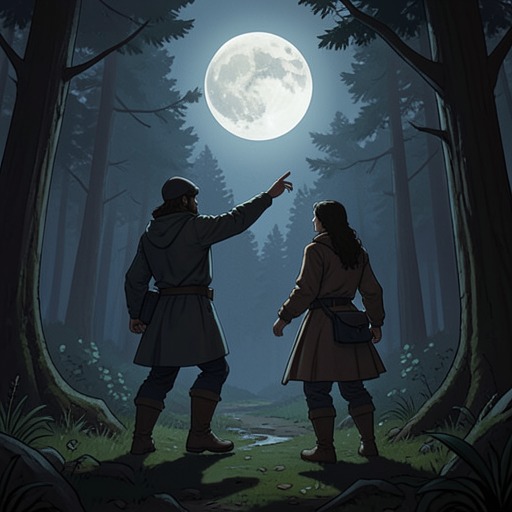
For Kelly, the full moon arrives less than a week after Max reveals that she is a werewolf. She has already rejected the idea that she could have changed without knowing it, but Max’s demonstration of his wolf form and his explanation of infection leave the coming moon as a practical danger. He takes her into the woods near sunset, not to invite a transformation, but to bring her to a secluded cottage he describes as a safe place. The bare room, soft blankets, and scarred walls suggest a space prepared to withstand what may happen there.
As the night approaches, Kelly’s first full-moon experience is registered through her body and senses. Pain and pleasure ripple through her; she trembles, her eyes water, and the forest seems brighter and louder. She can hear Max’s heartbeat and is momentarily soothed by it, then finds its steady rhythm provoking her to disturb it. Her attention narrows from conversation and surroundings to sensation and impulse. Max tells her not to fight and assures her she is safe, while her reactions show how little ordinary reassurance can govern the approaching frenzy.
The episode gives Kelly’s new condition a concrete timetable. Her werewolf identity was first presented to her as an explanation for illness and a transformation she had never witnessed; now the moon makes that identity an immediate physical reality. Later, she and Max walk through the forest on the day of the full moon, and she reflects on the intensity of their mate bond. She also asks why they are in the woods if they do not turn that night. The question brings the lore into everyday practice: knowing the rule does not remove the need to prepare for the night’s other dangers.
Wren’s Public Crisis
Wren’s first encounter with the full-moon curse occurs in circumstances that sharply contrast with Kelly’s protected setting. After a dog attacks her during a run in Central Park, she becomes seriously ill and spends two days in a private hospital suite in a near-coma. When she recovers, her abilities seem heightened: she can run faster, see farther, and hear better than she remembers. A week later comes the full moon, while she is attending dinner with investors in her family’s firm.
Wren can barely remember what happened during the night. The next morning she wakes in chains in the psychiatric ward of the same hospital where she had been treated. The moon has transformed a private, unexplained illness into a public and institutional crisis. For a woman raised in the Longwood family, the discovery that she is a werewolf also collides with an identity shaped by status and family expectations; her family later treats her condition as something to research and manage. The full moon’s consequences thus extend beyond the body into confinement, family judgment, and the question of whether she will be accepted at home.
Abigail, Jacob, and the Moon’s Call
Abigail experiences the moon from captivity. Three days after falling ill, she is pacing in a cage, aware that another girl is being held nearby but unable to speak with her. As the summer night advances, Abigail feels the moon’s call through the wall and recognizes a wild presence that has persisted since she woke from her coma-like state. She tries to suppress it. The scene makes the full moon a force she senses before she can understand or name its cause.
When Jacob rescues her, Abigail is already caught in the night’s altered state. Outside, she turns her face toward the bright moon and cries out, longing to become part of it. Jacob continues to move her toward safety, while her attention is drawn toward the moon and her impulses overwhelm ordinary restraint. The contrast is central to the rescue: Jacob is trying to get them away from danger, while Abigail experiences the same night as a powerful summons. Her wristband supplies her name, but it is the moon-driven episode that gives Jacob—and, later, Abigail herself—a reason to reconsider what she has become.
After Abigail and Jacob are reunited with Kelly and Max, Abigail identifies the full moon as the explanation for her behavior during the rescue. Jacob initially assumes werewolves turn into wolves on that night. Max corrects him: they can shift into wolves at other times, but on the full moon they are cursed to act like beasts. The distinction reframes Jacob’s memory of Abigail’s apparent loss of control, and he responds that he already knows how much fun the full moon can be. Abigail’s experience is also part of a wider pattern: Kelly tells her that Abigail became ill less than a week earlier, matching the infection-and-moon timeline Max had described.
Narrative and Thematic Significance
Across Kelly, Wren, and Abigail, the full moon repeatedly marks the failure of a person’s existing explanation for their body. Kelly moves from disbelief toward firsthand recognition; Wren’s barely remembered night ends in hospital chains; Abigail feels the moon’s pull while imprisoned and later understands her conduct through Max’s account of the curse. The settings vary—from a prepared cottage to an investors’ dinner, a hospital ward, and a rescue under the open sky—but each makes the same cycle consequential in a different way.
The full moon also distinguishes supernatural inheritance from conscious choice. The characters may later learn to shift, understand the rules, or decide where to seek help, but the full-moon compulsion arrives before that knowledge can guarantee control. Max’s explanation gives the phenomenon a historical origin; the characters’ crises show its present cost. As a recurring time in the story, the full moon is at once calendar, diagnosis, and ordeal: it reveals what has been hidden, while showing that revelation alone does not make the body obedient or the surrounding world safe.